Complaints
One of the main reason Melbourne's citizens wrote to the City Council was to complain.
Some of the complaints were within the Council's powers or about its services. Some were not.
Our interactive interactive Subject Index reveals a litany of complaints, filed under a vast range of headings that captured the concerns of Melburnians in 1925. Although in many cases only the clerks' notes in the index and registers survive, they are a window into the daily life and constant change at the heart of the city.
Blasting
Blasting complaints &c at [cr] Wrights Lane & Lit Bourke St3176
During 1925, the Victorian Hardware Club began to construct a new building for its social functions on the corner of Wrights Lane and Little Bourke Street.
Excavation of the foundations for the new building concerned the neighbours, who complained at the office of the City Engineer H.E. Morton on 23 June.
Their complaints were well-founded: the very next day, their building at 394-6 Little Bourke Street collapsed dramatically into the excavations. Fortunately, workers on the construction site had noticed cracking in the wall, and sixty construction workers and eighteen occupants of the building escaped just in time.
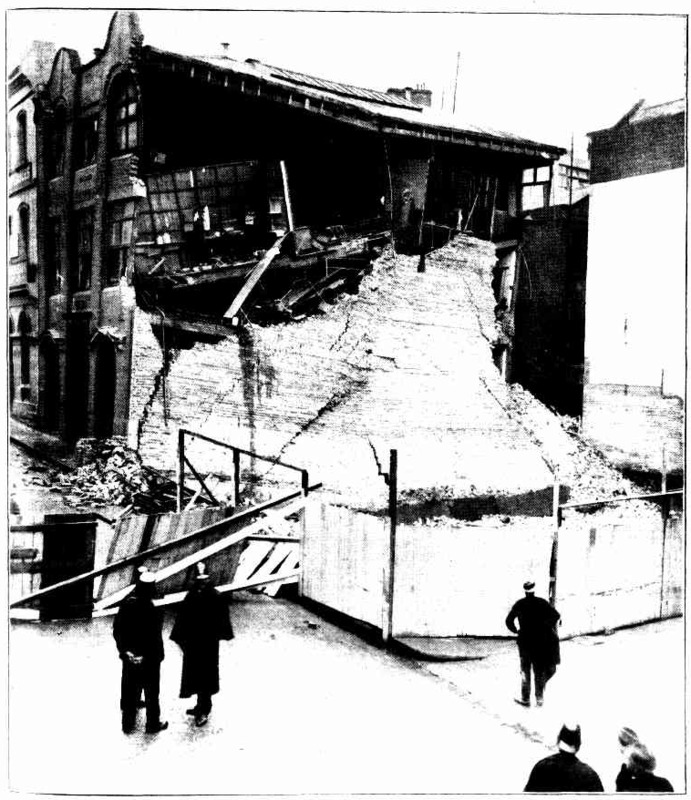
This was the third major collapse in the city for 1925, and one of the previous incidents had resulted in four fatalities. After the collapse, A.H. Enticott, the art engraver who had occupied the collapsed bulding, told newspaper reporters he had been the complainant to the City Council, fearing a repeat of recent events. City Engineer Morton promised a safe demolition and a thorough investigation.
References
- "Building Falls," Argus, 25 June 1925, 11.
- "£10,000 Damage," Herald, 25 June 1925, 1.
Cattle
Cattle complaint, re wandering Oak & Poplar Sts. Royal Park
5866
Cattle complaint, re wandering in Kensington
3066
On 12 November, the Medical Superintendent of the Royal Park Mental Hospital wrote to complain of cattle and horses being grazed on the verges of Royal Park near Oak Street and Poplar Road.
Horses and cattle were a common sight in this part of the city, and they had a long history. Oak Street and Poplar Road was home to the Commonwealth Serum Laboratories, which maintained a model farm for production of its animal-based vaccines and medications. The Horse, Cow and Pig Market operated on the corner of Flemington Road and Royal Parade, just a mile away, and herds of stock could be droved from here to the City Council's abattoirs along Racecourse Road.
But times were changing. Motor vehicles were replacing horses as the city's delivery vehicle of choice, and the need to support them was gradually disappearing. Several newspapers, most recently the Herald had begun a campaign to push cattle out of the parks that they now saw as "Melbourne's Potential Playgrounds". By the 1930s, the markets would fall silent, and with them the problem of grazing cattle.
References
- "Royal Park: For Cattle or Kiddies?," Sun, 6 February 1923, 14.
- "Melbourne's Potential Playgrounds," Herald, 7 March 1925, 14.
Flusher
Flusher No 1 complaint re same drenching persons in motor car
1741
Despite decades of effort to pave the streets, lanes and footpaths of the city, dust in the streets remained a perennial problem for the City Council. As many as forty watering carts, or "flushers", had featured in the effort to keep dust under control for many years, but they created their own problems.
In the early 1920s, the Council purchased a state-of-the-art motor flusher. It was costly, and ratepayers complained in the newspapers about the long delays getting it on the road.
On Monday they cleaned up the Flusher;— John T. Barratt, "Flusher or Four-Flusher?", Herald, 6 November 1922, 8.
On Tuesday they painted it green;
On Wednesday and Thursday the Council declared,
"Oh, ain't it a bonza machine!"
On Friday they filled it with Petrol
And greased it all over with lard—
But on Saturday someone said, "P'raps it might rain,"
So they shoved it back into the yard.
When it finally entered service in late November 1922, City Engineer H.E. Morton warned that "passers-by should take care than they do not get a bath", and pleaded especially with motor car drivers to be careful as they sped past the slow-moving truck.
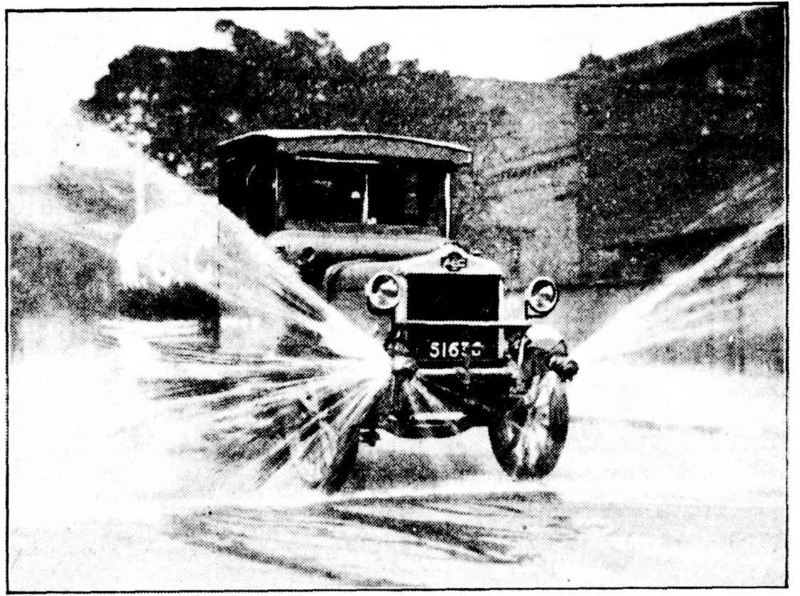
Mr Zlotkowski – apparently a vistor from out of state – was blissfully unaware of these warnings, and in 1925, he wrote to complain that he and his passengers had been "drenched" by the infamous No. 1 flusher.
References
- "Look Out For Baths!," Herald, 11 November 1922, 1.
- "City Council's New Sprinkler," Herald, 30 June 1923, 18.
Acknowledgements
- Text: Patrick Gigacz