Angela Varga (1925–)
Identifier
140.0000
Title
Angela Varga (1925–)
Type
person
Contributor
Jane Eckett
Birth Date
1925
Birthplace
Vienna, Austria
Occupation
sculptor, painter, mural artist
Biography
Born in Vienna in 1925, the daughter of Hugó Varga and ceramic sculptor and portrait artist Ida Móricz Varga (1894–1987), and niece of novelist Zsigmond Móricz, Angela Varga's family were of Hungarian origins—part of the then recently dissolved Habsburgs Empire. She was just fourteen years old at the outbreak of WW2, when she enrolled at the Wiener Kunstgewerbeschule (Vienna School of Applied Art), studying jewellery and sculpture there under Eugen Mayer. This renowned pioneering school had strong ties with the Wiener Werkstätte; for an account of the school's ceramic studio see Emmanuel Cooper, Lucie Rie: modernist potter (Yale, 2012), 36–47.
After the war she progressed to the Academy of Fine Arts in Vienna, 1945–46, studying sculpture with Prof. Fritz Wotruba, life drawing with Herbert Boeckl, and painting with Sergius Pauser. Following this, she went to Paris in 1947 to study painting with Jean Dupas at the École des Beaux Arts. Between periods of formal study, she worked from Wotruba's studio on Böcklinstrasse, Vienna.
In early 1950 Varga travelled to England, via Switzerland, to join her sister Kate, who was then working in London as a nurse and would later marry Abbey sculptor Peter King, and friend Helen Grünwald. During this period she stayed with Grünwald at the Abbey for a few months. In March that year, the private secretary to Sir Kenneth Clark gave Grünwald and Varga a private tour of his collection, Clark being away at the time. Grünwald afterwards invited Clark to the Abbey, specifically to view Varga’s work, describing Varga as "a very gifted young painter-sculptor" who "only narrowly escaped being transported by the Nazis during the war" and who, since the end of the war, "has firmly established herself as one of the foremost artists in her country" (Grünwald to Clark, 17 May 1950, TGA 8812/1/2/2696). Varga was due to return to Vienna in the first week of June, and Grünwald hoped Clark might write a reference for her to support her return to England to study at "one of the London Schools of Art, or possibly, the Slade" (Grunwald to Clark, 17 May 1950, TGA 8812/1/2/2696). Clark accepted Grünwald’s invitation, writing in advance to Ohly that "Miss Grunwald is very anxious for me to see the work of a girl named Angela Varga, who is a student at the Abbey" and proposing a mutually convenient date (Clark to Ohly, 18 May 1950, TGA 8812/1/2/4850). The visit eventuated in the late afternoon of 26 May 1950. Clark soon afterwards provided the much-needed reference for "Miss Weiss-Varga," commenting to Grünwald that "it must be lovely for you to find someone with a talent so akin to your own, because, although there are naturally differences in your work, the vision and sympathies are very much the same" (Clark to Grünwald, 30 May 1950, TGA 8812/1/2/2698). A week later, Varga was accepted at the Slade (Grünwald to Clark, 7 June 1949, TGA 8812/1/2/2699).
Varga was back in London by mid-October 1950 to commence study at the Slade, specialising in painting and printmaking. She also studied mural painting and ceramics at the Central School of Fine Arts. During this time she lived at the Abbey Art Centre. Varga's London sketchbooks include rapid pencil sketches drawn on the spot at Billingsgate Fish Market (also a favoured subject of Grünwald's), Smithfield Meat Market, and Covent Garden. Her Paris sketchbook of the early 1950s was unfortunately stolen, though she afterwards sketched Les Halles from memory.
Varga returned to Vienna in 1953, working there independently and exhibiting with the Neuer Hagenbunde (established in 1948 by Rudolf Richly and Cary Hauser). In 1954 she founded the Keramik Varga workshop, which operated until 1972. She held her first solo show in 1955, at the Neue Galerie Grünangergasse, following which she began receiving commissions for wall designs, executed, from 1956 onwards, from her studio in Modenapark. Further exhibitions were held in 1958 at the Galerie Gurlitt in Munich, Wuppertal Museum, and London's New Art Center.
In November 1965 she exhibited sculpture (bronze reliefs), jewellery and paintings at the Molton Gallery, London. The Illustrated London News reviewed it positively, describing her as "a painter and printmaker who is better known on the continent than in England" and "a master of line as her delightful small etchings, priced at only 15 guineas, show" ("Pieces for collectors," ILN, 27 November 1965, p. 53). In the same year she also exhibited at the Österreichisches Museum für Angewandte Kunst (Austrian Museum for Applied Arts, now MAK) and was was awarded both the Theodor Körner Preis and the Preis des Wiener Kunstfonds (Vienna Art Fund Prize), winning the latter again in 1966.
After the war she progressed to the Academy of Fine Arts in Vienna, 1945–46, studying sculpture with Prof. Fritz Wotruba, life drawing with Herbert Boeckl, and painting with Sergius Pauser. Following this, she went to Paris in 1947 to study painting with Jean Dupas at the École des Beaux Arts. Between periods of formal study, she worked from Wotruba's studio on Böcklinstrasse, Vienna.
In early 1950 Varga travelled to England, via Switzerland, to join her sister Kate, who was then working in London as a nurse and would later marry Abbey sculptor Peter King, and friend Helen Grünwald. During this period she stayed with Grünwald at the Abbey for a few months. In March that year, the private secretary to Sir Kenneth Clark gave Grünwald and Varga a private tour of his collection, Clark being away at the time. Grünwald afterwards invited Clark to the Abbey, specifically to view Varga’s work, describing Varga as "a very gifted young painter-sculptor" who "only narrowly escaped being transported by the Nazis during the war" and who, since the end of the war, "has firmly established herself as one of the foremost artists in her country" (Grünwald to Clark, 17 May 1950, TGA 8812/1/2/2696). Varga was due to return to Vienna in the first week of June, and Grünwald hoped Clark might write a reference for her to support her return to England to study at "one of the London Schools of Art, or possibly, the Slade" (Grunwald to Clark, 17 May 1950, TGA 8812/1/2/2696). Clark accepted Grünwald’s invitation, writing in advance to Ohly that "Miss Grunwald is very anxious for me to see the work of a girl named Angela Varga, who is a student at the Abbey" and proposing a mutually convenient date (Clark to Ohly, 18 May 1950, TGA 8812/1/2/4850). The visit eventuated in the late afternoon of 26 May 1950. Clark soon afterwards provided the much-needed reference for "Miss Weiss-Varga," commenting to Grünwald that "it must be lovely for you to find someone with a talent so akin to your own, because, although there are naturally differences in your work, the vision and sympathies are very much the same" (Clark to Grünwald, 30 May 1950, TGA 8812/1/2/2698). A week later, Varga was accepted at the Slade (Grünwald to Clark, 7 June 1949, TGA 8812/1/2/2699).
Varga was back in London by mid-October 1950 to commence study at the Slade, specialising in painting and printmaking. She also studied mural painting and ceramics at the Central School of Fine Arts. During this time she lived at the Abbey Art Centre. Varga's London sketchbooks include rapid pencil sketches drawn on the spot at Billingsgate Fish Market (also a favoured subject of Grünwald's), Smithfield Meat Market, and Covent Garden. Her Paris sketchbook of the early 1950s was unfortunately stolen, though she afterwards sketched Les Halles from memory.
Varga returned to Vienna in 1953, working there independently and exhibiting with the Neuer Hagenbunde (established in 1948 by Rudolf Richly and Cary Hauser). In 1954 she founded the Keramik Varga workshop, which operated until 1972. She held her first solo show in 1955, at the Neue Galerie Grünangergasse, following which she began receiving commissions for wall designs, executed, from 1956 onwards, from her studio in Modenapark. Further exhibitions were held in 1958 at the Galerie Gurlitt in Munich, Wuppertal Museum, and London's New Art Center.
In November 1965 she exhibited sculpture (bronze reliefs), jewellery and paintings at the Molton Gallery, London. The Illustrated London News reviewed it positively, describing her as "a painter and printmaker who is better known on the continent than in England" and "a master of line as her delightful small etchings, priced at only 15 guineas, show" ("Pieces for collectors," ILN, 27 November 1965, p. 53). In the same year she also exhibited at the Österreichisches Museum für Angewandte Kunst (Austrian Museum for Applied Arts, now MAK) and was was awarded both the Theodor Körner Preis and the Preis des Wiener Kunstfonds (Vienna Art Fund Prize), winning the latter again in 1966.
In 1966 she exhibited at the Institut für Kulturelle Beziehungen in Budapest as part of a retrospective for her mother Ida Móricz Varga. Her work was exhibited at Galerie 1640 in concert with the Montreal Expo of 1967; Haus Irene Koch, Reken, 1968; Galerie Clasing, Münster, 1969; Nancy Pool Gallery, Toronto, 1972; Goethe Institute, Brussels, 1976; Mattersburg Kulturzentrum, 1980; Galerie am Edelhof, Großhöflein, 1993; and Caestecker Fine Arts Gallery, Wisconsin, 1999, which hosted a retrospective titled "Three women, three generations: Ida Móricz Varga, Angela Varga, and Iby-Jolande Varga".
Jane Eckett
13 January 2026
Bibliography
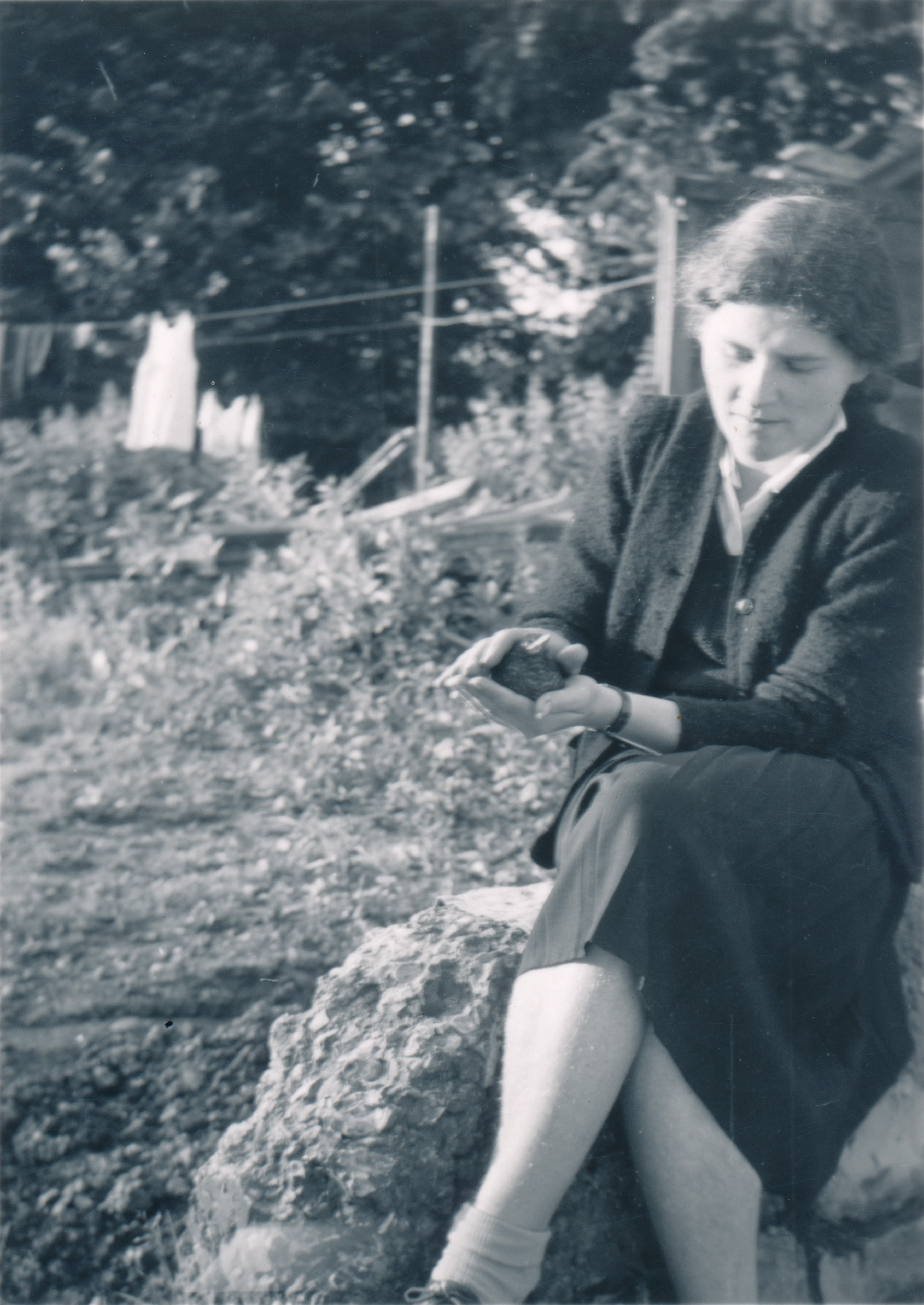
Photograph (i)
Angela Varga with a young thrush she rescued from a cat, at the Abbey Art Centre, c. 1950–53, courtesy the artist
Date submitted
12 August 2021
Date modified
13 January 2026
Collection
Citation
“Angela Varga (1925–),” The Abbey Art Centre Digital Repository, accessed October 27, 2026, https://omeka.cloud.unimelb.edu.au/abbey-art-centre/items/show/1007.